Underground Water:
A Sustainable Solution
Water is an essential element for life and the development of human activity.
In a context of structural drought at a global level, underground waters have proven to be a viable and sustainable solution. Unlike large supply networks, which have a high energy footprint and low water quality (coming from reservoirs, desalination plants and wastewater), the use of underground water allows a local, efficient and high-quality supply.
Currently, a significant part of water consumption in rural areas already comes from veins or aquifers. In addition, combined with other water resources, underground water can be key to guaranteeing water supply in larger areas, such as those intended for irrigated agriculture.
The Origin
of the Groundwater
There are two main theories about the origin of underground waters:
Traditional hydrogeology holds that all underground water comes from the atmospheric cycle. According to this theory, rainwater infiltrates the subsoil, forming aquifers over time, especially near river basins. This explanation is valid for shallow aquifers (up to 150 metres), but does not contemplate the full complexity of the subsoil.
• The theory of native or primary waters, increasingly accepted, suggests that, in addition to the atmospheric cycle, water is produced continuously inside the Earth’s crust. This primary water is first supercritical vapor, then vapor, and finally water that rises due to its pressure through faults to the exterior.
• According to this theory, there are different levels of underground waters: super-deep rivers, deep veins and shallow aquifers. These freshwater underground waters are calculated to make up 98% of total freshwater.


Our Method: Combination
of Tradition
and Technology
At Saurí Online, we combine the ancestral knowledge of the saurins with the most modern techniques of geophysical analysis of the subsoil.
This combination allows us to obtain very reliable results in the location of underground water, with a high success rate. Although no method can guarantee 100% effectiveness, our approach allows us to offer the best guarantees in the search for aquifers.
Radiesthesia and Telerradiesthesia Radiesthesia is an ancestral art documented since time immemorial. Cave paintings already show saurins using rods to detect water, and this knowledge has been transmitted through the great civilizations to the present day.
Since the 16th century, radiesthesia has interacted with scientific and cultural currents, and in the 20th century the modern theoretical bases of this practice were established. In addition to water prospecting, radiesthesia has been used in the detection of minerals and other underground elements.
There are two main modalities of radiesthesia:
• Physical radiesthesia It is based on the idea that bodies emit waves, ions or magnetic fields that can be perceived by the saurí.
• Mental radiesthesia It is based on the ability of the unconscious mind to capture invisible realities through a process of concentration. This method has been well documented by researchers such as Antoine Luzy in France or Father Pilón in Spain.
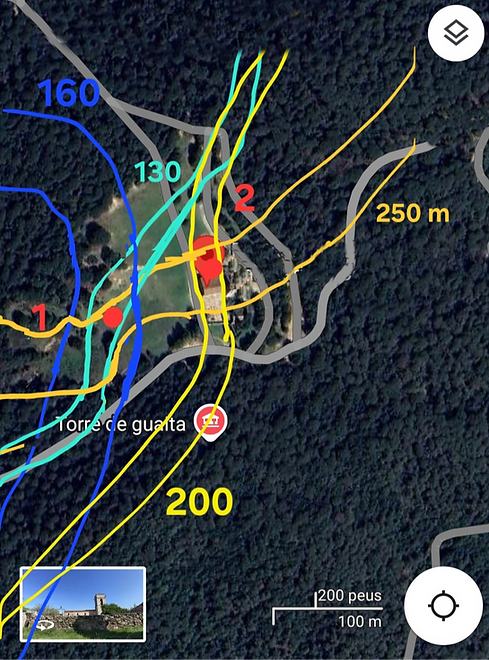
At Saurí Online, we use this second method of prospecting. First, we carry out a map study to identify possible water zones. Then, we physically check the viability of the site with advanced radioelectric analysis instruments.
It is not our objective to debate whether physical and mental radiesthesia are the same or whether one is a variant of the other. What is important is that, when performed correctly, radiesthesia provides valuable and reliable information about underground waters.
An Art and a Technology
in the Service
of the Water
Although radiesthesia is not an exact science, it is a prospecting art that, combined with modern geophysical techniques, allows us to determine with high precision where a drilling should be carried out to access underground water.
With this method, we offer a sustainable and efficient solution to locate and harness available water resources, helping to guarantee water supply in a world increasingly affected by drought.